
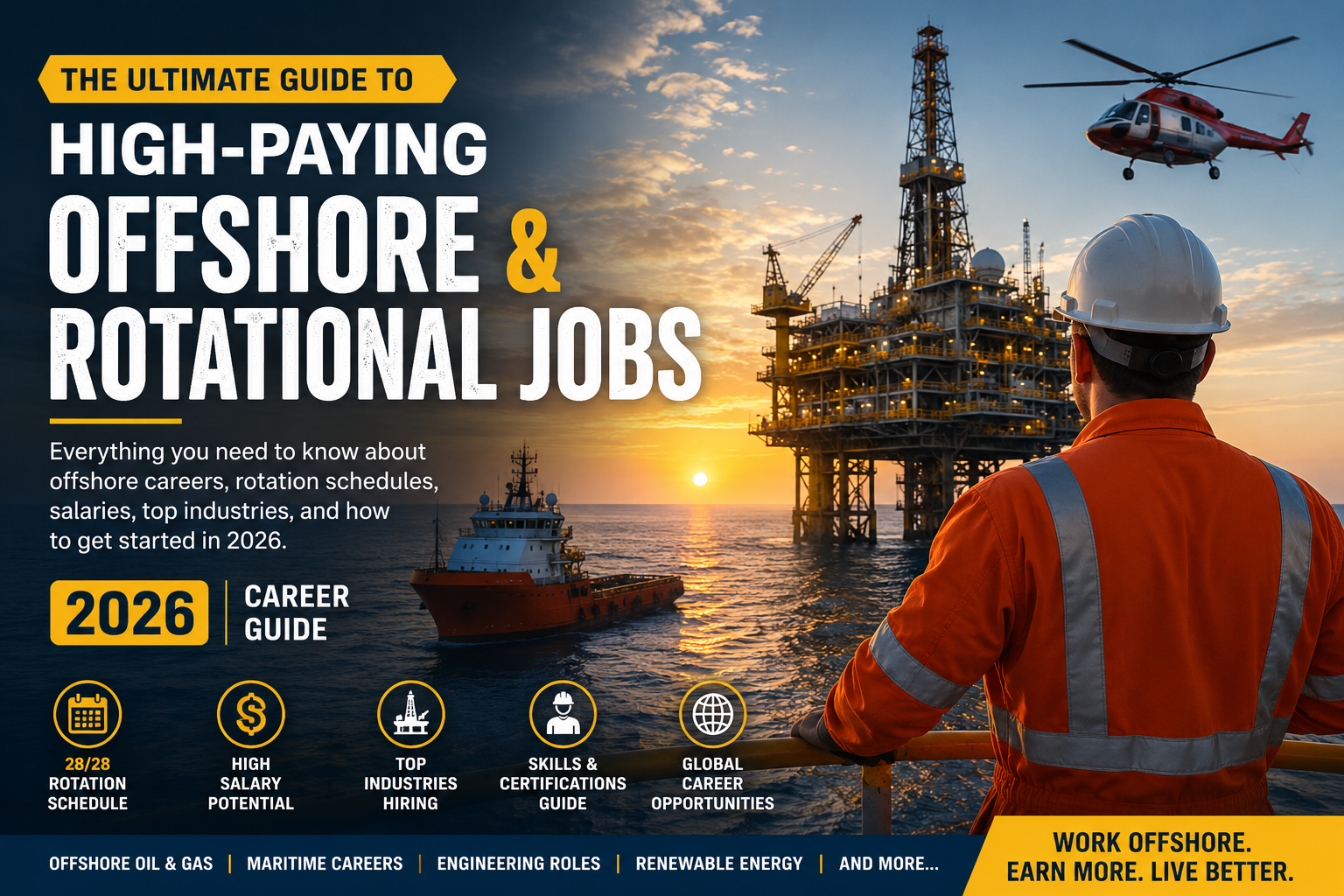
The Ultimate Guide to High-Paying Offshore & Rotational Jobs (2026)
Discover everything you need to know about offshore rotational careers, salary expectations, 28/28 work schedules, oil & gas jobs, maritime careers, and how to start working offshore.
The Complete Guide to High-Paying Offshore and Rotational Jobs
Imagine working for four weeks and then enjoying the next four weeks completely free. No daily commuting, no weekend office work, and no routine nine-to-five schedule. Instead, you spend several weeks working in a remote location before returning home for an extended period of leave. This is the reality for thousands of professionals employed in offshore rotational careers around the world.
Offshore rotational jobs have become one of the most attractive career paths for experienced engineers, technicians, electricians, instrument specialists, crane operators, mechanics, production operators, marine officers, safety professionals, and many other skilled workers. These positions are common in industries where operations continue twenty-four hours a day throughout the year.
Unlike conventional employment, rotational work allows companies to maintain continuous production while employees follow fixed schedules such as 14 days on and 14 days off, 21 days on and 21 days off, or the increasingly popular 28/28 rotation schedule. Once one crew completes its assignment, another crew arrives to continue operations without interruption.
Did You Know?
Many offshore professionals spend nearly half of the year at home while maintaining a full-time career through rotational work schedules.
What is an Offshore Rotational Job?
An offshore rotational job is a work arrangement where employees remain at an offshore installation, vessel, platform, or remote industrial facility for a predetermined number of days before returning home for an equally defined leave period. These schedules help employers maintain uninterrupted operations while providing employees with structured time away from work.
Because offshore locations are often hundreds of kilometers from shore, daily commuting is impossible. Employers therefore provide accommodation, meals, transportation within the worksite, medical support, and other essential facilities during each rotation.
Many offshore professionals appreciate the predictable work pattern because it allows them to plan family commitments, travel, education, and personal projects during their leave periods.
Common Offshore Rotation Schedules
| Rotation | Work Days | Leave Days | Industries |
|---|---|---|---|
| 14 / 14 | 14 | 14 | Wind Energy, Maintenance |
| 21 / 21 | 21 | 21 | Marine, Offshore Energy |
| 28 / 28 | 28 | 28 | Oil & Gas, FPSO, Drilling |
| 35 / 35 | 35 | 35 | International Offshore Projects |
| 42 / 42 | 42 | 42 | Remote Mining & Construction |
Top Industries Hiring for Rotational Work in 2026
Although offshore oil and gas remains the best-known sector for rotational employment, many industries now rely on similar work schedules to support projects in remote or continuously operating environments. Advances in renewable energy, marine logistics, infrastructure, telecommunications, and industrial maintenance have created new opportunities for skilled professionals who prefer structured work rotations.
Depending on the employer and project location, rotational schedules may range from two weeks to six weeks before employees return home for an extended leave period. These schedules help companies maintain continuous operations while allowing employees to enjoy predictable time off between assignments.
Oil, Gas & Energy Projects
The offshore oil and gas industry continues to employ thousands of engineers, technicians, electricians, instrument specialists, production operators, drilling personnel, crane operators, HSE professionals, marine crews, and maintenance teams.
Major offshore regions include the North Sea, Gulf of Mexico, Middle East, West Africa, Brazil, Australia, and Southeast Asia. These projects often operate around the clock, requiring multiple rotational crews throughout the year.
Maritime & Merchant Navy Careers
Merchant ships, offshore support vessels, research vessels, dredgers, heavy-lift ships, and LNG carriers commonly operate with rotational crews. Marine engineers, deck officers, electricians, ETOs, cooks, fitters, and ratings often work on contracts lasting several weeks or months before scheduled leave.
Offshore Wind Energy
The rapid expansion of offshore wind farms has increased demand for wind turbine technicians, rope access specialists, commissioning engineers, electrical engineers, and subsea cable installation teams. Many renewable energy companies now offer rotational work similar to offshore oil and gas projects.
Remote Construction & Industrial Projects
Large infrastructure developments in remote areas—including mining operations, LNG terminals, power plants, refineries, and industrial facilities—often rely on rotational workforces. Construction managers, welders, pipefitters, QA/QC inspectors, scaffolders, riggers, and supervisors may all work on rotation.
High-Paying Offshore Jobs in 2026
Salary packages vary according to experience, employer, location, certifications, tax regulations, and project complexity. The following table provides general salary estimates for experienced professionals working in international offshore projects. Actual compensation may differ significantly between employers.
| Job Role | Typical Rotation | Estimated Annual Salary (USD) |
|---|---|---|
| Offshore Installation Manager (OIM) | 28/28 | $150,000 – $260,000 |
| Toolpusher | 28/28 | $120,000 – $210,000 |
| Drilling Engineer | 28/28 | $110,000 – $190,000 |
| Marine Engineer | 28/28 | $90,000 – $160,000 |
| Instrument Technician | 28/28 | $65,000 – $120,000 |
| Electrical Technician | 28/28 | $65,000 – $120,000 |
| Mechanical Technician | 28/28 | $60,000 – $115,000 |
| Production Operator | 21/21 | $70,000 – $130,000 |
| Crane Operator | 28/28 | $80,000 – $145,000 |
| HSE Officer | 28/28 | $75,000 – $140,000 |
Note:
Salary estimates are provided for informational purposes only and represent broad international ranges. Actual earnings depend on employer policies, country, experience, overtime, taxation, and contract terms.
Essential Certifications for Offshore Careers
Most offshore employers require candidates to complete mandatory safety training before joining a project. Depending on your role, additional technical certifications may also be required.
| Certification | Purpose |
|---|---|
| BOSIET | Basic Offshore Safety & Emergency Training |
| FOET | Refresher Offshore Emergency Training |
| HUET | Helicopter Underwater Escape Training |
| OGUK / Offshore Medical | Medical fitness assessment |
| H2S Safety | Hydrogen Sulfide awareness |
| Working at Height | Fall protection training |
| Confined Space Entry | Safe entry procedures |
| First Aid | Emergency medical response |
Additional certifications may be required depending on your trade, employer, and country of operation.
Who Can Apply for Offshore Rotational Jobs?
Many offshore employers recruit experienced professionals from engineering, marine, industrial maintenance, manufacturing, and construction backgrounds.
- Mechanical Engineers
- Electrical Engineers
- Instrumentation Engineers
- Automation Engineers
- Marine Engineers
- Production Operators
- Mechanical Technicians
- Electrical Technicians
- Instrument Technicians
- Crane Operators
- Welders
- Pipefitters
- Riggers
- Scaffolders
- Roustabouts
- Derrickmen
- Assistant Drillers
- Drillers
- Safety Officers
- Quality Inspectors
While experienced professionals generally have stronger employment prospects, entry-level opportunities may also be available depending on employer requirements, apprenticeship programs, and regional workforce needs.
Pros and Cons of the Offshore Lifestyle
An offshore career can be financially rewarding and professionally challenging. Before applying for rotational work, it is important to understand both the advantages and the demands of this lifestyle. Every project, employer, and location is different, so experiences may vary from one assignment to another.
| Advantages | Challenges |
|---|---|
| Competitive salaries | Extended periods away from family |
| Long leave rotations | Remote working environments |
| Career progression | Long daily work shifts |
| International experience | Strict safety procedures |
| Accommodation & meals often provided | Weather-related operational delays |
| Opportunity to save money | Limited internet or communication on some projects |
How to Start an Offshore Career
Breaking into the offshore industry takes preparation, especially if you are applying for technical or engineering roles. Employers generally look for candidates who have relevant qualifications, practical experience, and mandatory offshore safety certifications. Building a professional resume and staying updated with current vacancies can significantly improve your chances of securing interviews.
- Complete relevant technical education or vocational training.
- Gain practical experience in your trade or engineering discipline.
- Obtain mandatory offshore safety certifications if required.
- Create an ATS-friendly professional resume.
- Apply only through trusted employers and recruitment agencies.
- Prepare for technical and HR interviews.
- Maintain valid passports, medical certificates, and licenses.
Career Tip:
Tailoring your resume to match the job description can improve your chances of being shortlisted by Applicant Tracking Systems (ATS).
Prepare for Offshore Jobs with MyCareers.pro
Whether you’re applying for your first offshore role or looking for your next rotational assignment, MyCareers.pro offers free career resources to help you prepare.
| Career Tool | Purpose |
|---|---|
| ATS Resume Checker | Check whether your resume is optimized for Applicant Tracking Systems. |
| Smart Resume Builder | Create a professional engineering or offshore resume. |
| Resume Templates | Download recruiter-friendly resume layouts. |
| Cover Letter Generator | Create customized cover letters for job applications. |
| Interview Questions | Practice common HR and technical interview questions. |
| Interview Simulator | Improve confidence with mock interviews. |
| Latest Jobs | Browse offshore, engineering, maritime, and energy vacancies. |
| Submit Your CV | Increase your visibility with recruiters. |
Frequently Asked Questions
What is a 28/28 rotation schedule?
A 28/28 rotation means employees work offshore for 28 consecutive days before receiving 28 consecutive days of leave. Actual work hours and rotation policies vary by employer and project.
Are offshore rotational jobs suitable for beginners?
Some entry-level opportunities exist, but many offshore employers prefer candidates with relevant technical experience, safety certifications, or vocational training.
Which industries offer rotational jobs?
Rotational work is common in offshore oil and gas, offshore wind, maritime, LNG, mining, heavy construction, remote telecommunications, and industrial maintenance.
Do offshore companies provide accommodation?
Many employers provide accommodation, meals, transportation during the work period, and other site facilities. Benefits vary depending on the contract and employer.
How much can offshore professionals earn?
Compensation depends on the employer, country, position, experience, certifications, overtime, and contract terms. Highly specialized roles may command significantly higher salaries than entry-level positions.
Final Thoughts
Offshore rotational careers continue to attract skilled professionals seeking competitive salaries, international experience, and structured work-life schedules. While these careers involve demanding environments and extended time away from home, they also offer opportunities for career development, financial growth, and exposure to advanced engineering and industrial technologies.
Success in the offshore industry depends on technical competence, safety awareness, teamwork, continuous learning, and professional preparation. Keeping your certifications current, maintaining an updated resume, and following trusted recruitment sources can improve your chances of securing future opportunities.
Whether you are an engineer, technician, marine professional, or skilled tradesperson, understanding how rotational work operates can help you make informed career decisions and prepare for opportunities in the global energy and maritime sectors.