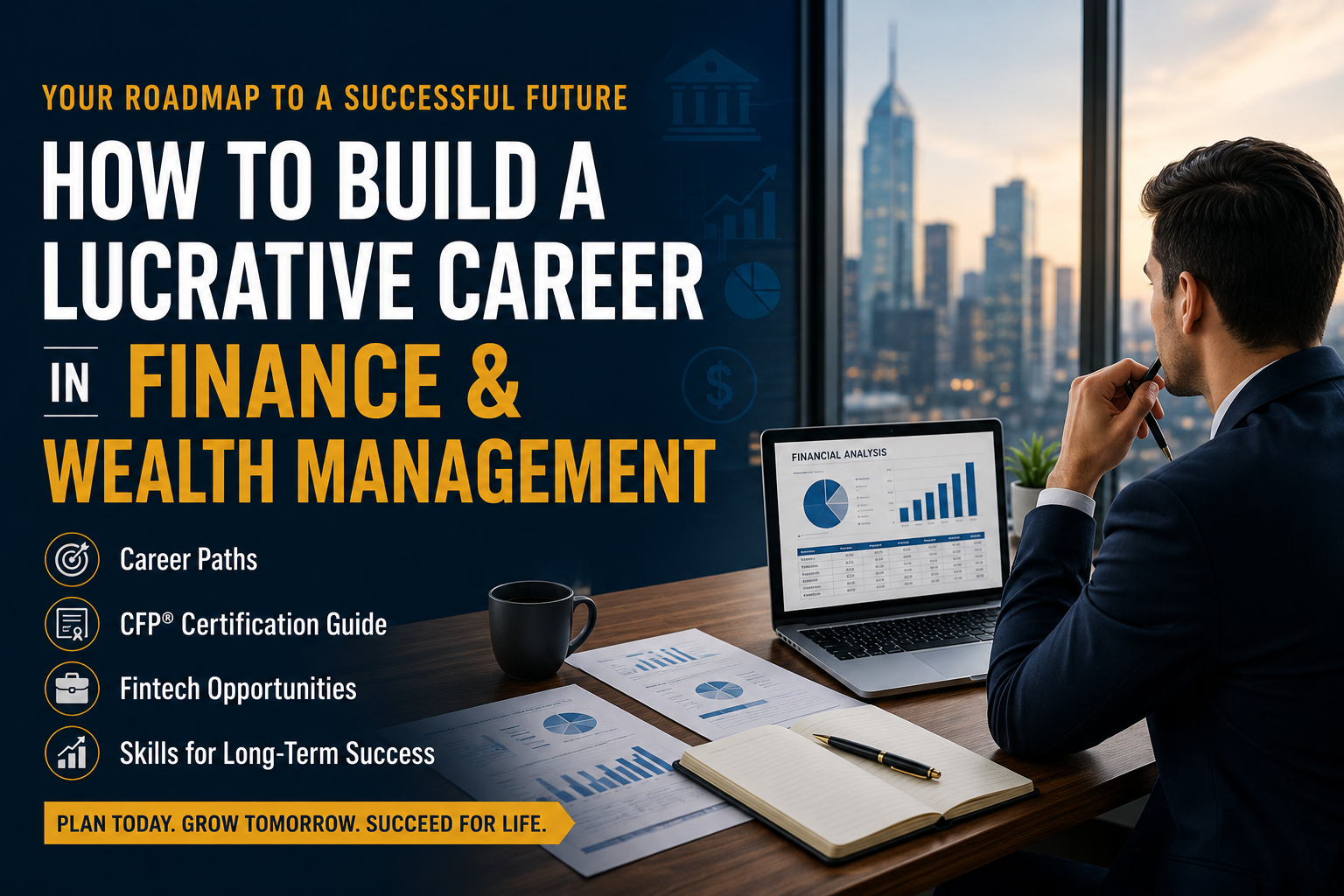
How to Build a Lucrative Career in Finance and Wealth Management

Finance and Wealth Management


How to Build a Lucrative Career in Finance and Wealth Management

Finance is one of the world’s most diverse professional industries, offering opportunities in financial planning, corporate finance, investment management, digital banking, fintech, consulting, and wealth management. Whether you enjoy analysing financial data, helping clients achieve long-term goals, or supporting business growth, there are multiple career paths available.


Start Reading

 

Finance professional reviewing investment charts

Key Takeaways

  • Finance offers career paths beyond investment banking, including wealth management, financial planning, corporate finance, fintech, compliance, and risk management.
  • Certified Financial Planner (CFP®) certification requirements vary by country, but generally include education, examination, experience, and ethical standards.
  • Corporate finance and wealth management involve different responsibilities and career progression opportunities.
  • Fintech companies continue creating new roles across payments, digital banking, analytics, compliance, and financial technology.
  • Communication, ethics, relationship management, analytical thinking, and continuous learning remain valuable throughout a finance career.

Table of Contents

Why Finance Continues to Attract Professionals

Few industries offer as many career options as finance. While many people immediately think of investment banking or stock markets, the financial sector includes banking, insurance, accounting, corporate finance, retirement planning, financial advisory services, investment research, asset management, compliance, risk analysis, and rapidly growing fintech companies.

One of the strengths of a finance career is its flexibility. Professionals often move between industries while applying the same core financial knowledge. For example, someone working in corporate finance may later transition into investment analysis, while an experienced financial planner might move into wealth management or private banking. These transferable skills make finance an attractive long-term career choice for people who enjoy continuous learning and professional development.

The industry has also changed significantly in recent years. Digital banking, mobile payments, artificial intelligence, financial analytics, and regulatory technology have created new career opportunities that combine traditional financial expertise with modern technology. As a result, employers increasingly look for professionals who can understand financial principles while adapting to changing business environments.

Career Insight

Successful finance professionals rarely stop learning. Continuing education, professional certifications, industry knowledge, and strong ethical standards play an important role in long-term career growth regardless of the specific finance specialty you choose.

Corporate Finance vs. Wealth Management: Which Path Is Right for You?

One of the first decisions many finance professionals face is choosing between corporate finance and wealth management. While both careers involve financial decision-making and analytical thinking, they focus on different clients, responsibilities, and long-term objectives.

Corporate finance professionals help businesses manage money, improve profitability, evaluate investments, control costs, and support long-term financial planning. Wealth management professionals work directly with individuals and families, helping them manage investments, retirement planning, tax strategies, estate planning, and long-term financial goals.

Neither path is universally better. The right choice depends on your interests, personality, preferred work environment, and career aspirations.

Quick Comparison

Category Corporate Finance Wealth Management
Primary Focus Business financial performance Personal financial planning
Main Clients Companies & Organizations Individuals & Families
Typical Work Budgeting, forecasting, investments Retirement, investments, estate planning
Communication Level Moderate Very High
Analytical Work Very High High
Relationship Building Internal stakeholders Long-term client relationships
Career Growth Finance Manager → CFO Advisor → Senior Wealth Manager

Corporate Finance Career Path

Corporate finance professionals help businesses make informed financial decisions. Their responsibilities often include preparing budgets, analyzing financial statements, evaluating investment opportunities, forecasting future performance, managing cash flow, supporting mergers and acquisitions, and improving overall financial efficiency.

Many professionals begin their careers as finance analysts before progressing into senior analyst, finance manager, financial controller, director of finance, or chief financial officer (CFO) positions.

Who enjoys Corporate Finance?

Corporate finance may suit professionals who enjoy analytical work, business strategy, financial modeling, data interpretation, and supporting organizational decision-making.

Wealth Management Career Path

Wealth management focuses on helping clients build, preserve, and transfer wealth over time. Professionals work closely with individuals, families, entrepreneurs, and retirees to understand their financial objectives and recommend suitable strategies based on each client’s circumstances.

Services may include investment planning, retirement planning, education savings, insurance planning, tax-efficient strategies, estate planning coordination, and ongoing portfolio reviews. Depending on local regulations, professionals may also provide financial planning or investment advisory services within their licensed scope of practice.

Who enjoys Wealth Management?

Professionals who enjoy building long-term relationships, communicating complex financial concepts clearly, and helping clients achieve financial goals often find wealth management rewarding.

Typical Employers

Corporate Finance

  • Public Companies
  • Private Businesses
  • Manufacturing Companies
  • Healthcare Organizations
  • Technology Companies
  • Retail Businesses
  • Government Agencies

Wealth Management

  • Private Banks
  • Investment Advisory Firms
  • Financial Planning Practices
  • Family Offices
  • Asset Management Companies
  • Insurance & Retirement Firms
  • Independent Advisory Businesses

Which Career Fits Your Personality?

If You Prefer… You May Enjoy…
Business Strategy Corporate Finance
Working with Individual Clients Wealth Management
Financial Analysis Corporate Finance
Relationship Building Wealth Management
Budget Planning Corporate Finance
Retirement Planning Wealth Management
Internal Business Decisions Corporate Finance
Personal Financial Advice Wealth Management

Shared Skills Across Both Careers

Although these career paths differ in their daily responsibilities, they share many important professional skills. Building these capabilities early can support long-term career development regardless of the specialization you choose.

Skill Why It Matters
Financial Analysis Supports informed decision-making.
Critical Thinking Helps evaluate risks and opportunities.
Communication Explains financial information clearly.
Ethics & Integrity Builds trust with employers and clients.
Attention to Detail Improves accuracy in financial reporting.
Technology Skills Supports modern financial tools and reporting platforms.
Continuous Learning Finance regulations and markets evolve over time.

Career Tip:

If you’re unsure which path to choose, consider internships, graduate programs, informational interviews, or networking with professionals in both fields. First-hand conversations and practical experience often provide clearer insights than job descriptions alone.

Steps to Becoming a Certified Financial Planner (CFP)

Many professionals searching for how to become a Certified Financial Planner are interested in building a long-term career helping individuals and families make informed financial decisions. CFP certification is widely recognized in many countries, but the exact certification requirements vary depending on the organization responsible for administering the credential in each region.

Although specific rules differ, most certification pathways follow four broad areas: education, examination, practical experience, and ethical standards. Before beginning your journey, always review the requirements published by the official CFP certification body where you intend to practice.

Important:

Certification requirements, examination formats, continuing education obligations, and eligibility criteria differ between countries. Always verify the latest information through the official CFP organization in your jurisdiction.

Education and Coursework Requirements

Education forms the foundation of a successful financial planning career. Many aspiring financial planners begin with studies in finance, accounting, economics, business administration, commerce, mathematics, or related disciplines. Depending on the certification authority, additional CFP education modules or approved coursework may also be required before taking the certification examination.

Formal education helps candidates understand budgeting, investments, taxation, retirement planning, insurance, estate planning, ethics, and client relationship management. Beyond academic qualifications, many employers value practical communication skills, professionalism, and the ability to explain complex financial concepts in a way clients can understand.

Learning Area Purpose
Financial Planning Principles Understanding personal financial planning concepts.
Investment Fundamentals Learning investment products and portfolio concepts.
Risk Management Evaluating financial risks and insurance solutions.
Retirement Planning Planning long-term financial security.
Tax Fundamentals Understanding taxation principles.
Estate Planning Preparing wealth transfer strategies.
Professional Ethics Supporting responsible financial advice.

Passing the CFP Examination

The CFP examination is designed to evaluate a candidate’s understanding of financial planning principles and their ability to apply knowledge to practical situations. Rather than memorizing formulas alone, candidates are generally expected to analyze client scenarios, identify financial objectives, evaluate risks, and recommend appropriate planning approaches.

Successful preparation usually combines structured coursework, consistent revision, practice questions, and time management. Many candidates also join study groups or review courses to strengthen areas where they need additional support.

Preparation Tips

  • Create a realistic study schedule.
  • Review official learning materials.
  • Practice case-based questions.
  • Understand financial planning concepts.
  • Improve time management skills.

Exam Day Advice

  • Read every question carefully.
  • Manage your time effectively.
  • Avoid rushing difficult questions.
  • Stay calm and focused.
  • Review answers when possible.

Gaining Practical Experience

Professional experience is an important part of becoming an effective financial planner. Depending on the certification body, candidates may need to complete a specified amount of qualifying experience before receiving certification.

Practical experience allows future financial planners to work directly with clients, understand financial planning processes, prepare recommendations, analyze financial situations, and communicate solutions clearly. Working alongside experienced professionals can also help candidates develop ethical judgment and client relationship skills.

Experience Area Examples
Client Meetings Understanding financial goals.
Financial Analysis Reviewing financial information.
Investment Planning Supporting portfolio discussions.
Retirement Planning Preparing retirement strategies.
Documentation Preparing reports and recommendations.
Compliance Following regulatory requirements.

Professional Ethics and Continuing Education

Successful financial planners are expected to maintain high professional standards throughout their careers. Ethical conduct, transparency, confidentiality, and acting in the client’s best interests are essential responsibilities within financial planning.

Many professional organizations also require continuing education to help members remain informed about regulatory developments, financial products, investment markets, taxation changes, and emerging planning strategies.

Professional Insight

Building trust is one of the most valuable assets in financial planning. Technical knowledge is important, but long-term success also depends on integrity, communication, and consistently acting in clients’ best interests.

Emerging High-Paying Careers in Fintech and Digital Banking

Technology is transforming the financial services industry. Digital banking, online payments, artificial intelligence, blockchain, cloud computing, and financial analytics have created entirely new career opportunities that combine finance with technology. Professionals who understand both business and digital innovation are increasingly valuable across banks, payment companies, fintech startups, insurance providers, and investment firms.

Unlike traditional finance roles, many fintech positions involve collaboration with software developers, designers, compliance specialists, and product managers. This creates exciting opportunities for professionals who enjoy solving business problems while working with modern technology.

Popular Fintech Career Opportunities

Career Main Focus Typical Employers
Financial Analyst Business performance and reporting Banks, investment firms, corporations
Fintech Product Manager Digital financial products Fintech startups, SaaS companies
Digital Banking Specialist Online banking operations Commercial banks
Risk Analyst Financial risk assessment Banks, insurers, investment firms
Compliance Analyst Regulatory compliance Financial institutions
Payments Specialist Digital payment systems Payment companies
Financial Data Analyst Data reporting & insights Corporate finance & fintech
Investment Operations Portfolio administration Asset management firms

Technology Trends Shaping Modern Finance

Financial services continue to evolve as organizations adopt new technologies to improve efficiency, security, customer experience, and decision-making. Professionals who stay informed about emerging trends may find additional opportunities throughout their careers.

Artificial Intelligence

AI assists with fraud detection, customer support, financial analysis, document processing, and operational efficiency.

Digital Payments

Cashless transactions and payment platforms continue to expand globally.

Open Banking

Financial institutions increasingly collaborate through secure digital services and APIs.

ESG Investing

Environmental, Social, and Governance considerations are becoming more important for investors and financial institutions.

The Core Soft Skills Every Modern Financial Professional Needs

Technical knowledge is only one part of a successful finance career. Employers consistently value professionals who combine financial expertise with strong interpersonal and leadership skills. Whether you work in corporate finance, wealth management, fintech, banking, or investment analysis, these capabilities support long-term career growth.

Skill Why It Matters
Communication Explains financial information clearly to clients and colleagues.
Ethics Builds trust and supports responsible decision-making.
Critical Thinking Evaluates financial opportunities and potential risks.
Relationship Management Develops long-term professional and client relationships.
Leadership Supports collaboration and team performance.
Adaptability Responds effectively to changing markets and regulations.
Technology Literacy Uses financial software and digital tools efficiently.
Time Management Prioritizes competing deadlines and responsibilities.

Building Your Finance Career

A successful finance career rarely follows exactly the same path for everyone. Some professionals begin in accounting before moving into corporate finance, while others start in banking and later transition into wealth management, fintech, investment analysis, or financial planning. Continuous learning, professional networking, and gaining practical experience are often just as valuable as formal qualifications.

Developing a strong professional profile includes keeping your resume updated, improving communication skills, staying informed about industry developments, and pursuing relevant certifications that align with your chosen specialization.

Career Advice:

Choose certifications and learning opportunities that match your long-term career goals rather than collecting credentials without a clear purpose. Practical experience combined with continuous learning often has the greatest impact on career progression.

Frequently Asked Questions

Finance continues to offer diverse career opportunities across banking, wealth management, financial planning, corporate finance, investment management, insurance, and fintech. Career prospects depend on your qualifications, practical experience, communication skills, and willingness to continue learning.

The timeline varies depending on your educational background, professional experience, and the certification requirements in your country. Always refer to the official CFP organization where you plan to become certified.

Yes. Wealth management focuses on helping individuals and families achieve financial goals through long-term planning, while investment banking generally supports businesses with activities such as capital raising, mergers, acquisitions, and corporate transactions.

Yes. Many finance professionals build successful careers through bachelor’s degrees, professional certifications, practical experience, and continuous learning. Requirements vary by employer and specialization.

Fintech continues to create opportunities in digital banking, payment technologies, financial analytics, compliance, cybersecurity, artificial intelligence, and product management as organizations expand their digital services.

Helpful Career Resources

Preparing for a successful finance career involves more than academic qualifications. A professional resume, interview preparation, and continuous career development can help improve your employment prospects.

Career Resource Purpose
Smart Resume Builder Create a professional finance resume.
ATS Resume Checker Improve resume compatibility with Applicant Tracking Systems.
Resume Templates Explore recruiter-friendly resume layouts.
Interview Questions Practice common finance interview questions.
Interview Simulator Build confidence with mock interviews.
Career Advice Hub Read practical career guides and professional tips.
Latest Jobs Browse current career opportunities.
Submit Your CV Share your profile with recruiters.

Final Thoughts

Finance offers a wide variety of rewarding career paths, from corporate finance and wealth management to financial planning, digital banking, compliance, and fintech innovation. While each specialization requires different technical knowledge, successful professionals share several important qualities: integrity, analytical thinking, adaptability, effective communication, and a commitment to lifelong learning.

If you’re considering a career in finance, take time to understand the different career paths available, identify the skills you already possess, and explore education or certifications that align with your long-term goals. Practical experience, networking, and continuous professional development can help you build a sustainable and fulfilling career in the financial industry.

About MyCareers.pro

MyCareers.pro helps professionals prepare for successful careers through resume tools, interview preparation, career guidance, company insights, and practical learning resources across multiple industries.

Home |

About Us |

Company Reviews |

Career Advice |

Privacy Policy


Disclaimer:

This article is provided for educational and informational purposes only. Professional certification requirements, financial regulations, employment opportunities, and career pathways vary by country and may change over time. Always consult the official certification body or relevant regulatory authority for the most current requirements.

© MyCareers.pro. All Rights Reserved.


7 High-Paying Tech and Digital Jobs You Can Get Without Coding

high-paying-tech jobs without-coding

7 High-Paying Tech and Digital Jobs You Can Get Without Coding

A rewarding career in technology doesn’t always require becoming a software developer. Many of today’s fastest-growing roles focus on communication, business strategy, design, marketing, and leadership instead of programming.


Start Reading


Modern technology office

Key Takeaways

  • Technology companies hire thousands of professionals who never write production code.
  • Digital marketing, product management, UX design, customer success, and tech sales are among the fastest-growing careers.
  • Many professionals transition successfully from education, healthcare, engineering, retail, finance, and customer service.
  • Strong communication, analytical thinking, leadership, and problem-solving skills are often more valuable than programming knowledge.
  • Industry certifications and real-world projects help demonstrate practical skills to employers.
  • Remote and hybrid work opportunities are widely available across many technology companies.

Table of Contents

Why the Tech Industry Needs Non-Technical Talent

When people imagine working in technology, they often picture software developers writing code all day. While software engineering remains an essential profession, successful technology companies rely on much more than programming. Every digital product also needs professionals who understand customers, create marketing campaigns, improve user experiences, manage projects, analyze business performance, build partnerships, recruit talented employees, and provide customer support.

Consider a company that develops project management software. Developers build the platform, but digital marketers attract new customers, product managers prioritize features, designers improve usability, customer success teams help clients achieve results, and sales professionals introduce the software to businesses. Without these roles, even the best technology product would struggle to grow.

This growing demand has created thousands of opportunities for professionals who enjoy solving business problems, communicating with people, organizing projects, or creating engaging online experiences. Many of these careers offer competitive salaries, flexible working arrangements, and excellent long-term growth without requiring advanced programming knowledge.

Real Career Insight

Many successful digital marketers, product managers, and customer success professionals began their careers in completely different industries such as retail, hospitality, teaching, banking, healthcare, or engineering. They built transferable skills, completed targeted training, and gained practical experience through personal or freelance projects before moving into technology-focused roles.

Transferable Skills That Technology Companies Value

Communication

Explaining ideas clearly to customers, colleagues, and stakeholders is essential across nearly every technology role.

Problem Solving

Technology companies value professionals who can identify challenges, analyze situations, and recommend practical solutions.

Project Management

Planning work, meeting deadlines, and coordinating teams are valuable skills in startups and large organizations alike.

Business Thinking

Understanding customer needs, market trends, and business objectives helps companies develop better products and services.

Traditional Career Technology Career
Teacher Customer Success Manager
Sales Executive SaaS Account Executive
Engineer Product Manager
Nurse Health Technology Specialist
HR Professional Technical Recruiter
Marketing Executive Digital Marketing Manager


1. Digital Marketing Manager & SEO Specialist

Digital marketing has become one of the fastest-growing career paths within the technology industry. Every software company, online marketplace, mobile application, and digital startup depends on attracting visitors, generating leads, and converting potential customers into paying users. This creates strong demand for professionals who understand search engines, online advertising, content strategy, email marketing, analytics, and social media.

Unlike software engineering, digital marketing focuses on understanding customer behavior rather than writing application code. Professionals use data to improve website visibility, increase traffic, and help businesses grow online.

Main Responsibilities

  • Search Engine Optimization (SEO)
  • Google Ads Campaigns
  • Content Marketing
  • Email Marketing
  • Website Analytics
  • Keyword Research
  • Conversion Optimization

Useful Skills

  • Google Analytics
  • Search Console
  • Copywriting
  • Content Strategy
  • Problem Solving
  • Communication
  • Data Interpretation
Experience Level Typical Responsibilities
Entry Level Content writing, social media, reporting
Mid-Level SEO strategy, paid advertising, campaign management
Senior Level Marketing leadership and growth strategy

2. Product Manager

Product Managers help guide the development of digital products by working closely with designers, engineers, marketers, customer support teams, and business stakeholders. Their primary responsibility is identifying customer needs and deciding which improvements should be developed first.

Although Product Managers work with technical teams every day, they are not expected to write production software. Instead, they coordinate planning, communicate priorities, analyze customer feedback, and ensure everyone is working toward the same objectives.

Real-World Example

Imagine customers frequently request a new reporting feature inside a software application. Instead of building the feature themselves, a Product Manager researches customer demand, discusses technical feasibility with engineers, estimates business impact, and prioritizes development based on available resources.

Daily Activities Business Value
Product Planning Defines future product direction
Customer Interviews Identifies real customer problems
Roadmap Management Prioritizes development work
Cross-Team Communication Keeps departments aligned
Feature Evaluation Improves customer satisfaction

3. Scrum Master / Agile Project Manager

Modern technology companies often organize projects using Agile methodologies. Scrum Masters support development teams by facilitating meetings, removing obstacles, improving collaboration, and helping projects progress efficiently. Rather than acting as traditional managers, Scrum Masters serve as facilitators who encourage communication and continuous improvement.

Professionals entering this field commonly come from project coordination, operations, engineering, consulting, or business administration backgrounds.

Typical Tasks

  • Sprint Planning
  • Daily Stand-up Meetings
  • Retrospectives
  • Project Coordination
  • Risk Management
  • Stakeholder Communication

Professional Skills

  • Leadership
  • Organization
  • Facilitation
  • Conflict Resolution
  • Communication
  • Decision Making

Comparing These Career Paths

Career Coding Required? Creativity Communication Growth Potential
Digital Marketing No ★★★★★ ★★★★★ ★★★★★
SEO Specialist No ★★★★☆ ★★★★☆ ★★★★★
Product Manager No ★★★★☆ ★★★★★ ★★★★★
Scrum Master No ★★★☆☆ ★★★★★ ★★★★★

Helpful Certifications

While certifications are not a substitute for practical experience, they can demonstrate commitment to learning and provide structured knowledge. Hiring managers often value certifications when combined with real projects, internships, volunteer work, or measurable achievements.

Career Recommended Certification
Digital Marketing Google Digital Marketing & E-commerce Certificate
SEO Google Analytics Certification
Product Management Product School Fundamentals
Scrum Master Professional Scrum Master (PSM) or Certified ScrumMaster (CSM)

Tip:

Rather than collecting many certificates, focus on completing one respected certification and applying what you’ve learned through personal projects, freelance work, internships, or volunteer experience. Employers often look for evidence that you can apply your skills in real situations.

4. UX/UI Designer

User Experience (UX) and User Interface (UI) designers help create digital products that are intuitive, accessible, and enjoyable to use. Rather than writing software, they focus on understanding user behavior, designing layouts, improving navigation, and ensuring that websites and applications solve real problems efficiently.

Many UX professionals come from graphic design, marketing, psychology, customer service, architecture, or creative industries. Modern design tools such as Figma and Adobe XD allow designers to build interactive prototypes without programming knowledge.

Typical Responsibilities

  • User Research
  • Wireframing
  • Prototyping
  • Design Systems
  • Accessibility Improvements
  • Usability Testing

Useful Tools

  • Figma
  • Adobe XD
  • Miro
  • Notion
  • Maze
  • Canva

5. Tech Sales & Account Executive

Technology companies depend on skilled sales professionals to explain products, understand customer requirements, and build lasting business relationships. Instead of selling physical products, many Account Executives introduce cloud software, cybersecurity solutions, AI platforms, and SaaS products to businesses.

Strong communication, negotiation, and relationship-building skills are usually more valuable than technical coding knowledge.

Primary Responsibility Business Impact
Product Demonstrations Educates potential customers
Client Meetings Builds trust and relationships
Negotiations Supports revenue growth
Account Management Improves customer retention

6. Customer Success Manager

Customer Success Managers focus on helping customers achieve value after purchasing a product or service. Instead of finding new clients, they work with existing customers by providing onboarding, training, adoption guidance, and ongoing support.

Technology companies increasingly invest in Customer Success because retaining existing customers is often more cost-effective than acquiring new ones.

7. Technical Recruiter

Technical Recruiters help companies identify and hire professionals for engineering, cybersecurity, cloud computing, product management, design, and IT operations. They coordinate interviews, review resumes, communicate with candidates, and support hiring managers throughout the recruitment process.

People with HR, business administration, recruitment, or customer-facing experience often transition successfully into technical recruiting roles.

How to Pivot Into a Tech Career Without Coding

Changing careers doesn’t always require starting from scratch. Many skills developed in other industries are highly transferable to technology roles. Communication, leadership, project planning, customer service, organization, and analytical thinking are valuable across a wide range of technology careers.

Your Current Career Possible Tech Career
Teacher Customer Success Manager
Engineer Product Manager
Retail Manager Operations Manager
Sales Professional SaaS Account Executive
HR Executive Technical Recruiter
Healthcare Professional Health Technology Specialist

Frequently Asked Questions

No. Many employers focus on practical skills, experience, communication abilities, and relevant certifications rather than specific degrees.

Yes. Entry-level opportunities exist in customer success, digital marketing, recruiting, technical sales, and project coordination.

Choose a certification that aligns with your target role. Google Digital Marketing, Professional Scrum Master, and the Google UX Certificate are common starting points.

Many technology companies offer remote or hybrid positions, although availability varies by employer and role.

Final Thoughts

The technology industry offers many rewarding careers beyond software development. Whether your strengths lie in communication, creativity, organization, leadership, or business strategy, there are opportunities to build a successful career without becoming a programmer.

Focus on developing practical skills, building a portfolio where appropriate, completing relevant certifications, and applying your existing experience to technology roles that value your strengths. Continuous learning and curiosity are often more important than following a traditional career path.

Continue Your Career Journey

Explore more career resources on MyCareers.pro, including resume tools, interview preparation, company reviews, career advice, and job opportunities designed to help professionals advance their careers.

Home |

Jobs List |

Company Reviews |

Career Advice


© MyCareers.pro. This article is intended for educational and career guidance purposes only. Salary expectations, certifications, and hiring requirements vary between employers and locations.


The Ultimate Guide to High-Paying Offshore & Rotational Jobs (2026)

High-Paying Offshore & Rotational Jobs

The Ultimate Guide to High-Paying Offshore & Rotational Jobs (2026)

Discover everything you need to know about offshore rotational careers, salary expectations, 28/28 work schedules, oil & gas jobs, maritime careers, and how to start working offshore.

The Complete Guide to High-Paying Offshore and Rotational Jobs

Imagine working for four weeks and then enjoying the next four weeks completely free. No daily commuting, no weekend office work, and no routine nine-to-five schedule. Instead, you spend several weeks working in a remote location before returning home for an extended period of leave. This is the reality for thousands of professionals employed in offshore rotational careers around the world.

Offshore rotational jobs have become one of the most attractive career paths for experienced engineers, technicians, electricians, instrument specialists, crane operators, mechanics, production operators, marine officers, safety professionals, and many other skilled workers. These positions are common in industries where operations continue twenty-four hours a day throughout the year.

Unlike conventional employment, rotational work allows companies to maintain continuous production while employees follow fixed schedules such as 14 days on and 14 days off, 21 days on and 21 days off, or the increasingly popular 28/28 rotation schedule. Once one crew completes its assignment, another crew arrives to continue operations without interruption.

Did You Know?

Many offshore professionals spend nearly half of the year at home while maintaining a full-time career through rotational work schedules.

What is an Offshore Rotational Job?

An offshore rotational job is a work arrangement where employees remain at an offshore installation, vessel, platform, or remote industrial facility for a predetermined number of days before returning home for an equally defined leave period. These schedules help employers maintain uninterrupted operations while providing employees with structured time away from work.

Because offshore locations are often hundreds of kilometers from shore, daily commuting is impossible. Employers therefore provide accommodation, meals, transportation within the worksite, medical support, and other essential facilities during each rotation.

Many offshore professionals appreciate the predictable work pattern because it allows them to plan family commitments, travel, education, and personal projects during their leave periods.

Common Offshore Rotation Schedules

Rotation Work Days Leave Days Industries
14 / 14 14 14 Wind Energy, Maintenance
21 / 21 21 21 Marine, Offshore Energy
28 / 28 28 28 Oil & Gas, FPSO, Drilling
35 / 35 35 35 International Offshore Projects
42 / 42 42 42 Remote Mining & Construction

Top Industries Hiring for Rotational Work in 2026

Although offshore oil and gas remains the best-known sector for rotational employment, many industries now rely on similar work schedules to support projects in remote or continuously operating environments. Advances in renewable energy, marine logistics, infrastructure, telecommunications, and industrial maintenance have created new opportunities for skilled professionals who prefer structured work rotations.

Depending on the employer and project location, rotational schedules may range from two weeks to six weeks before employees return home for an extended leave period. These schedules help companies maintain continuous operations while allowing employees to enjoy predictable time off between assignments.

Oil, Gas & Energy Projects

The offshore oil and gas industry continues to employ thousands of engineers, technicians, electricians, instrument specialists, production operators, drilling personnel, crane operators, HSE professionals, marine crews, and maintenance teams.

Major offshore regions include the North Sea, Gulf of Mexico, Middle East, West Africa, Brazil, Australia, and Southeast Asia. These projects often operate around the clock, requiring multiple rotational crews throughout the year.


Maritime & Merchant Navy Careers

Merchant ships, offshore support vessels, research vessels, dredgers, heavy-lift ships, and LNG carriers commonly operate with rotational crews. Marine engineers, deck officers, electricians, ETOs, cooks, fitters, and ratings often work on contracts lasting several weeks or months before scheduled leave.

Offshore Wind Energy

The rapid expansion of offshore wind farms has increased demand for wind turbine technicians, rope access specialists, commissioning engineers, electrical engineers, and subsea cable installation teams. Many renewable energy companies now offer rotational work similar to offshore oil and gas projects.

Remote Construction & Industrial Projects

Large infrastructure developments in remote areas—including mining operations, LNG terminals, power plants, refineries, and industrial facilities—often rely on rotational workforces. Construction managers, welders, pipefitters, QA/QC inspectors, scaffolders, riggers, and supervisors may all work on rotation.

High-Paying Offshore Jobs in 2026

Salary packages vary according to experience, employer, location, certifications, tax regulations, and project complexity. The following table provides general salary estimates for experienced professionals working in international offshore projects. Actual compensation may differ significantly between employers.

Job Role Typical Rotation Estimated Annual Salary (USD)
Offshore Installation Manager (OIM) 28/28 $150,000 – $260,000
Toolpusher 28/28 $120,000 – $210,000
Drilling Engineer 28/28 $110,000 – $190,000
Marine Engineer 28/28 $90,000 – $160,000
Instrument Technician 28/28 $65,000 – $120,000
Electrical Technician 28/28 $65,000 – $120,000
Mechanical Technician 28/28 $60,000 – $115,000
Production Operator 21/21 $70,000 – $130,000
Crane Operator 28/28 $80,000 – $145,000
HSE Officer 28/28 $75,000 – $140,000

Note:

Salary estimates are provided for informational purposes only and represent broad international ranges. Actual earnings depend on employer policies, country, experience, overtime, taxation, and contract terms.

Essential Certifications for Offshore Careers

Most offshore employers require candidates to complete mandatory safety training before joining a project. Depending on your role, additional technical certifications may also be required.

Certification Purpose
BOSIET Basic Offshore Safety & Emergency Training
FOET Refresher Offshore Emergency Training
HUET Helicopter Underwater Escape Training
OGUK / Offshore Medical Medical fitness assessment
H2S Safety Hydrogen Sulfide awareness
Working at Height Fall protection training
Confined Space Entry Safe entry procedures
First Aid Emergency medical response

Additional certifications may be required depending on your trade, employer, and country of operation.

Who Can Apply for Offshore Rotational Jobs?

Many offshore employers recruit experienced professionals from engineering, marine, industrial maintenance, manufacturing, and construction backgrounds.

  • Mechanical Engineers
  • Electrical Engineers
  • Instrumentation Engineers
  • Automation Engineers
  • Marine Engineers
  • Production Operators
  • Mechanical Technicians
  • Electrical Technicians
  • Instrument Technicians
  • Crane Operators
  • Welders
  • Pipefitters
  • Riggers
  • Scaffolders
  • Roustabouts
  • Derrickmen
  • Assistant Drillers
  • Drillers
  • Safety Officers
  • Quality Inspectors

While experienced professionals generally have stronger employment prospects, entry-level opportunities may also be available depending on employer requirements, apprenticeship programs, and regional workforce needs.

Pros and Cons of the Offshore Lifestyle

An offshore career can be financially rewarding and professionally challenging. Before applying for rotational work, it is important to understand both the advantages and the demands of this lifestyle. Every project, employer, and location is different, so experiences may vary from one assignment to another.

Advantages Challenges
Competitive salaries Extended periods away from family
Long leave rotations Remote working environments
Career progression Long daily work shifts
International experience Strict safety procedures
Accommodation & meals often provided Weather-related operational delays
Opportunity to save money Limited internet or communication on some projects

How to Start an Offshore Career

Breaking into the offshore industry takes preparation, especially if you are applying for technical or engineering roles. Employers generally look for candidates who have relevant qualifications, practical experience, and mandatory offshore safety certifications. Building a professional resume and staying updated with current vacancies can significantly improve your chances of securing interviews.

  1. Complete relevant technical education or vocational training.
  2. Gain practical experience in your trade or engineering discipline.
  3. Obtain mandatory offshore safety certifications if required.
  4. Create an ATS-friendly professional resume.
  5. Apply only through trusted employers and recruitment agencies.
  6. Prepare for technical and HR interviews.
  7. Maintain valid passports, medical certificates, and licenses.

Career Tip:

Tailoring your resume to match the job description can improve your chances of being shortlisted by Applicant Tracking Systems (ATS).

Prepare for Offshore Jobs with MyCareers.pro

Whether you’re applying for your first offshore role or looking for your next rotational assignment, MyCareers.pro offers free career resources to help you prepare.

Career Tool Purpose
ATS Resume Checker Check whether your resume is optimized for Applicant Tracking Systems.
Smart Resume Builder Create a professional engineering or offshore resume.
Resume Templates Download recruiter-friendly resume layouts.
Cover Letter Generator Create customized cover letters for job applications.
Interview Questions Practice common HR and technical interview questions.
Interview Simulator Improve confidence with mock interviews.
Latest Jobs Browse offshore, engineering, maritime, and energy vacancies.
Submit Your CV Increase your visibility with recruiters.

Frequently Asked Questions

What is a 28/28 rotation schedule?

A 28/28 rotation means employees work offshore for 28 consecutive days before receiving 28 consecutive days of leave. Actual work hours and rotation policies vary by employer and project.

Are offshore rotational jobs suitable for beginners?

Some entry-level opportunities exist, but many offshore employers prefer candidates with relevant technical experience, safety certifications, or vocational training.

Which industries offer rotational jobs?

Rotational work is common in offshore oil and gas, offshore wind, maritime, LNG, mining, heavy construction, remote telecommunications, and industrial maintenance.

Do offshore companies provide accommodation?

Many employers provide accommodation, meals, transportation during the work period, and other site facilities. Benefits vary depending on the contract and employer.

How much can offshore professionals earn?

Compensation depends on the employer, country, position, experience, certifications, overtime, and contract terms. Highly specialized roles may command significantly higher salaries than entry-level positions.

Final Thoughts

Offshore rotational careers continue to attract skilled professionals seeking competitive salaries, international experience, and structured work-life schedules. While these careers involve demanding environments and extended time away from home, they also offer opportunities for career development, financial growth, and exposure to advanced engineering and industrial technologies.

Success in the offshore industry depends on technical competence, safety awareness, teamwork, continuous learning, and professional preparation. Keeping your certifications current, maintaining an updated resume, and following trusted recruitment sources can improve your chances of securing future opportunities.

Whether you are an engineer, technician, marine professional, or skilled tradesperson, understanding how rotational work operates can help you make informed career decisions and prepare for opportunities in the global energy and maritime sectors.

About MyCareers.pro

MyCareers.pro is an independent career platform that helps job seekers discover employment opportunities, build professional resumes, prepare for interviews, and explore career resources across engineering, offshore, maritime, healthcare, IT, construction, and many other industries.

Home |
About Us |
Company Reviews |
Career Advice |
Jobs List |
Privacy Policy


Disclaimer: This guide is published for educational and informational purposes only. Salary estimates are approximate and may vary depending on employer, location, experience, certifications, taxation, and contract terms. Employment opportunities, hiring requirements, and compensation packages are determined solely by individual employers.

© 2026 MyCareers.pro. All Rights Reserved.


Tesla Careers 2026 27

Tesla Careers 2026 27

Explore career opportunities with Tesla including engineering, manufacturing, software development, production, automation, battery technology, quality engineering and corporate careers. Learn about the company, hiring process, skills, qualifications and resources to prepare for your next application.


Browse Latest Jobs


Electric vehicle manufacturing facility

Table of Contents

Tesla Company Overview

Tesla is a global manufacturer operating in the motor vehicle manufacturing industry with additional activities in energy storage, battery technologies, charging infrastructure, and renewable energy solutions. The company develops products designed for electric transportation and sustainable energy systems while supporting manufacturing, engineering, software, research, and customer service operations across multiple regions.

With a workforce exceeding 10,001 employees, Tesla offers opportunities across numerous professional disciplines. Depending on business requirements, positions may be available for engineers, technicians, software developers, production specialists, quality professionals, supply chain teams, project managers, finance professionals, and customer support staff.

Professionals interested in innovation, manufacturing technology, automation, robotics, artificial intelligence, battery systems, electrical engineering, and mechanical engineering frequently explore career opportunities with Tesla because of the company’s broad range of technical operations.

Career Tip:

Before applying, optimize your resume using our

ATS Resume Checker

to improve compatibility with Applicant Tracking Systems (ATS).

Company Information

Information Details
Company Name Tesla
Industry Motor Vehicle Manufacturing
Headquarters Austin, Texas, USA
Company Size 10,001+ Employees
Primary Business Electric Vehicles, Battery Storage & Clean Energy Technologies
Specialties Innovation in Electric Cars and Clean Energy Products

Business Areas

Tesla operates across several business segments that combine automotive manufacturing, advanced software, renewable energy, battery technology, automation, and industrial engineering. Rather than focusing on a single product category, the company develops technologies that support electric mobility and energy solutions for residential, commercial, and industrial customers.

The organization employs professionals from engineering, manufacturing, software development, logistics, finance, procurement, supply chain management, quality assurance, research and development, sales, customer support, and corporate operations. Business priorities and recruitment needs vary depending on projects and operational requirements.

Business Area Description
Electric Vehicles Design, manufacturing and support of electric passenger vehicles.
Battery Technology Development of battery systems and energy storage products.
Renewable Energy Solar technologies and sustainable energy solutions.
Manufacturing Production facilities, automation and industrial operations.
Software Vehicle software, digital platforms and connected technologies.
Service Operations Customer support, maintenance and technical service.

Career Opportunities

Career opportunities vary according to location, business requirements, and project needs. Positions may be available for experienced professionals, graduates, technicians, engineers, manufacturing specialists, software developers, and corporate employees.

Engineering Careers

Role Department
Mechanical Engineer Product Development
Electrical Engineer Manufacturing
Industrial Engineer Production
Automation Engineer Manufacturing Automation
Controls Engineer Industrial Systems
Quality Engineer Quality Assurance
Manufacturing Engineer Operations
Software Engineer Technology

Technical & Manufacturing Careers

Position Department
Production Technician Manufacturing
Mechanical Technician Maintenance
Electrical Technician Electrical Systems
Automation Technician Industrial Automation
Battery Technician Energy Systems
Service Technician Customer Service
Assembly Technician Production
Maintenance Technician Plant Operations

Skills Employers May Value

Specific qualifications depend on the position, but employers often look for candidates with relevant technical knowledge, practical experience, safety awareness, and problem-solving abilities. Demonstrating measurable achievements and industry certifications can strengthen an application.

Technical Skills Professional Skills
Mechanical Maintenance Communication
Electrical Systems Teamwork
Industrial Automation Leadership
PLC Fundamentals Problem Solving
CAD Software Time Management
Lean Manufacturing Adaptability
Quality Control Attention to Detail
Root Cause Analysis Continuous Learning

Preparing for the Recruitment Process

Preparing before applying can improve the quality of your application. Tailor your resume to match the job description, highlight technical achievements, list certifications, and include measurable results wherever possible. Practicing interview questions and researching the company can also help you communicate your experience more effectively.

Career Resources

Create a professional application using the tools available on MyCareers.pro.

Candidates can also improve their chances by gaining experience with manufacturing systems, automation technologies, industrial safety practices, and quality management processes. Continuing education, technical certifications, and practical project experience may be valuable depending on the role and location.

Frequently Asked Questions

Where is Tesla headquartered?

Tesla is headquartered in Austin, Texas, USA.

What industry does Tesla operate in?

Tesla operates in the Motor Vehicle Manufacturing industry while also developing battery storage systems, charging infrastructure, and renewable energy technologies.

Does Tesla hire internationally?

Recruitment depends on business requirements, local regulations, and available positions in different countries.

What qualifications are commonly required?

Requirements vary by role. Employers may seek engineering degrees, technical diplomas, vocational qualifications, certifications, or relevant work experience.

Are technician positions available?

Depending on operational needs, opportunities may include Production Technician, Maintenance Technician, Mechanical Technician, Electrical Technician, Automation Technician, and Service Technician.

How can I prepare for a Tesla interview?

Review the job description, practice technical and behavioral interview questions, and prepare examples from your previous projects and achievements.

More Career Resources

Resume Builder

Create an ATS-friendly professional resume.

Start Building →

Resume Templates

Download recruiter-friendly resume templates.

View Templates →

Career Advice

Interview tips, career planning and resume writing guides.

Read Articles →

Company Reviews

Explore employer profiles before applying.

Company Reviews →

Salary Calculator

Estimate salaries across different industries.

Calculate Salary →

Submit CV

Make your profile available to recruiters.

Submit Resume →

Start Your Career Journey

Whether you’re an experienced engineer, technician, graduate, or skilled professional, preparing your resume and continuously improving your skills can increase your chances of finding new career opportunities.

Use the free tools available on MyCareers.pro to create a professional resume, prepare for interviews, research employers, and discover international job opportunities.


Browse Latest Jobs


Disclaimer

This article is published by MyCareers.pro for informational and educational purposes only.

Tesla is an independent company. All trademarks, company names, logos, and registered trademarks belong to their respective owners.

MyCareers.pro is not affiliated with, endorsed by, sponsored by, or acting on behalf of Tesla. Company information, recruitment procedures, salaries, qualifications, and employment opportunities may change over time. Always verify current information through the employer’s official careers website before applying.


Johnson Controls Careers 2026

Johnson Controls Careers 2026

Complete Company Overview, Engineering Jobs, Technician Careers, Hiring Process, Skills & Career Resources.

Published By: MyCareers.pro

Category: Company Reviews

Johnson Controls Careers: Company Overview

Johnson Controls is a global technology company that develops products and services for intelligent buildings, HVAC systems, industrial refrigeration, fire protection, security technologies, and sustainability solutions. Its technologies are used across commercial buildings, hospitals, educational institutions, manufacturing plants, pharmaceutical facilities, industrial sites, airports, retail centers, and critical infrastructure worldwide.

The company has operations in multiple countries and employs more than 10,000 professionals across engineering, manufacturing, technical services, project management, operations, sales, and corporate functions.

Company Information Details
Company Name Johnson Controls
Industry Industrial Machinery Manufacturing
Headquarters Cork, Ireland
Employees 10,001+
Core Business Building Technologies, HVAC, Fire Protection, Security & Sustainability

About Johnson Controls

Johnson Controls provides technology solutions designed to improve building performance, increase energy efficiency, enhance occupant comfort, and support safer working environments. Its products and services are used by organizations ranging from small commercial businesses to large industrial facilities and public infrastructure projects.

Professionals interested in careers related to mechanical engineering, electrical engineering, instrumentation, automation, facility management, HVAC, fire protection, and energy management often explore opportunities with the company because of its broad portfolio of technologies and global reach.

If you’re preparing to apply for engineering or technical positions, creating a well-structured resume can improve your chances of passing applicant tracking systems (ATS). Try the
ATS Resume Checker
to evaluate your resume before submitting applications.

Industries Served

Johnson Controls delivers integrated building technologies and engineering solutions across a wide range of industries. Its products and services help organizations improve operational efficiency, reduce energy consumption, strengthen security, and maintain comfortable indoor environments.

Industry Solutions
Commercial Buildings HVAC, Building Automation, Security, Fire Protection
Healthcare Energy Management, Building Controls, Safety Systems
Manufacturing Industrial Refrigeration, Automation, Maintenance
Education Smart Building Technologies, HVAC Solutions
Data Centers Cooling Systems, Monitoring & Energy Efficiency
Retail & Hospitality Facility Management & Building Controls
Government Infrastructure Integrated Security & Fire Protection Systems

Career Opportunities

Career opportunities vary by country, business unit, and project requirements. Depending on hiring needs, Johnson Controls may recruit professionals from engineering, maintenance, manufacturing, automation, project management, and technical support backgrounds.

Engineering Careers

  • Mechanical Engineer
  • Electrical Engineer
  • Instrumentation Engineer
  • Automation Engineer
  • Controls Engineer
  • Project Engineer
  • Commissioning Engineer
  • Application Engineer
  • Sales Engineer

Technical Careers

  • Mechanical Technician
  • Electrical Technician
  • Instrument Technician
  • HVAC Technician
  • Fire Alarm Technician
  • Building Automation Technician
  • Refrigeration Technician
  • Maintenance Technician
  • Service Technician

Looking for Engineering Jobs?

Browse hundreds of international engineering and technical vacancies on our
Jobs List.

Skills Employers Often Value

The exact requirements vary depending on the role, but many technical positions seek candidates with knowledge or experience in the following areas.

Technical Skills Professional Skills
HVAC Systems Problem Solving
Electrical Maintenance Communication
Mechanical Maintenance Teamwork
Instrumentation Time Management
Industrial Automation Attention to Detail
Building Management Systems (BMS) Customer Service
PLC Fundamentals Safety Awareness
Energy Management Continuous Learning

Typical Hiring Process

Recruitment procedures can differ depending on the business unit and location. However, many employers follow a structured hiring process similar to the one below.

  1. Online Application
  2. Resume Screening
  3. HR Review
  4. Technical Assessment (if applicable)
  5. Technical Interview
  6. Manager Interview
  7. Background Verification
  8. Offer Letter
  9. Onboarding

Prepare Your Resume Before Applying

A well-structured resume can increase your chances of getting shortlisted. Tailor your resume to the specific position and highlight relevant technical skills, certifications, projects, and achievements.

ATS Resume Checker

Check whether your resume is optimized for Applicant Tracking Systems before submitting applications.

Open ATS Resume Checker →

Smart Resume Builder

Create a professional resume suitable for engineering and technical careers.

Create Resume →

Resume Templates

Explore modern resume layouts designed for recruiters and ATS software.

View Templates →

Cover Letter Generator

Generate a personalized cover letter to accompany your job application.

Generate Cover Letter →

Interview Preparation

Preparing for interviews can improve your confidence and help you explain your technical knowledge clearly. Review common engineering questions, practice behavioral interviews, and understand the employer’s business before attending an interview.

Interview Questions

Practice common HR and technical interview questions.

Practice Questions →

Interview Simulator

Build confidence by practicing interview scenarios online.

Start Simulator →

Career Advice Hub

Read practical guides on resumes, interviews, career planning, and professional development.

Visit Career Advice →

Career Path Quiz

Discover career paths based on your skills and interests.

Take the Quiz →

Frequently Asked Questions

Where is Johnson Controls headquartered?

Johnson Controls is headquartered in Cork, Ireland and operates across multiple countries worldwide.

What industry does Johnson Controls operate in?

The company operates in the Industrial Machinery Manufacturing sector while providing technologies for intelligent buildings, HVAC, building automation, fire protection, industrial refrigeration, and sustainability solutions.

Does Johnson Controls recruit internationally?

Recruitment depends on business requirements, local regulations, and available vacancies. Opportunities may be available in different countries depending on current hiring needs.

Which engineering disciplines are commonly recruited?

Depending on the role, employers may seek Mechanical, Electrical, Instrumentation, Automation, Controls, Project, and Commissioning Engineers.

Are technician jobs available?

Technical positions may include HVAC Technician, Mechanical Technician, Electrical Technician, Instrument Technician, Fire Alarm Technician, Building Automation Technician, and Service Technician.

Do I need prior experience?

Experience requirements vary by position. Some roles require experienced professionals, while entry-level opportunities may be available depending on business needs.

How can I improve my resume before applying?

Review your resume using our
ATS Resume Checker,
create a modern CV with our
Smart Resume Builder,
or browse our
Resume Templates.

How can I prepare for interviews?

Use our
Interview Questions
library and practice with our
Interview Simulator.

Career Resources from MyCareers.pro

Whether you’re searching for your next engineering opportunity or preparing for interviews, MyCareers.pro provides free tools to help you succeed throughout your career journey.

Browse Jobs

Explore international engineering and technical vacancies.

View Jobs →

Company Reviews

Research employers before submitting applications.

Read Reviews →

Salary Calculator

Estimate salary expectations and compare compensation.

Salary Calculator →

Career Advice

Read practical articles on interviews, resumes, and career growth.

Career Advice Hub →

Ready for Your Next Career Opportunity?

Create a professional resume, prepare for interviews, explore global employers, and submit your profile to increase your visibility with recruiters.


Submit Your CV →

Important Notice

This article is provided for informational purposes only. Company names, trademarks, and logos belong to their respective owners. Employment opportunities, qualifications, salaries, hiring decisions, and recruitment processes are managed solely by the employer.


Why Many Professionals Consider Johnson Controls

Every employer has its own work culture, projects, and career opportunities. Many professionals explore Johnson Controls because of its global operations, engineering-focused work environment, and involvement in building technologies.

Area Potential Benefits
Global Operations Projects in multiple countries and industries.
Engineering Projects Exposure to HVAC, automation, fire protection, and energy technologies.
Career Development Opportunities to develop technical and professional skills.
Innovation Work involving smart buildings and sustainability initiatives.
Team Environment Collaboration with multidisciplinary engineering teams.

Benefits and career experiences vary depending on location, employment type, department, and local employment policies.

Career Tips for Engineering & Technical Professionals

Competition for engineering and technical roles can be strong. Investing time in preparing your resume, developing technical skills, and researching employers can improve your application.

  • Customize your resume for every application.
  • Highlight certifications and licenses.
  • Include measurable achievements from previous roles.
  • Keep technical skills up to date.
  • Prepare examples of projects you’ve worked on.
  • Research the employer before interviews.
  • Practice answering technical and behavioral questions.
  • Maintain an updated LinkedIn profile and professional portfolio.

Need Career Guidance?

Visit our
Career Advice Hub
for articles covering resumes, interviews, career growth, workplace skills, and professional development.

Suggested Certifications for Engineering Professionals

Certification requirements depend on the employer and job role. The following certifications are commonly valued across engineering and technical industries.

Certification Area Examples
Health & Safety NEBOSH, IOSH, OSHA (where applicable)
Electrical Electrical Safety, High Voltage Awareness
Automation PLC Programming, SCADA Fundamentals
HVAC HVAC Service & Maintenance Training
Project Management PMP, CAPM (role dependent)
Instrumentation Industrial Instrumentation & Calibration

Explore Similar Career Opportunities

If you’re researching engineering employers, you may also be interested in companies involved in industrial automation, manufacturing, HVAC, building technologies, energy management, infrastructure, and industrial engineering.

  • Building Automation Companies
  • HVAC Manufacturers
  • Industrial Equipment Manufacturers
  • Energy Management Companies
  • Fire Protection Solution Providers
  • Industrial Engineering Employers
  • Automation & Controls Companies

Browse our growing collection of employer profiles in the
Company Reviews
section.

Continue Your Job Search

Finding the right opportunity often takes preparation. MyCareers.pro offers free tools designed to help candidates improve every stage of the job search process.

Create a Resume

Build an ATS-friendly resume in minutes.

Smart Resume Builder →

Check Resume Score

Improve your resume before applying.

ATS Resume Checker →

Browse Jobs

Search international job opportunities.

Latest Jobs →

Submit Your CV

Make your profile available for recruiters.

Submit CV →

Final Thoughts

Johnson Controls is recognized globally for its work in intelligent buildings, HVAC systems, building automation, industrial refrigeration, security technologies, and sustainability solutions. Career opportunities vary according to business requirements, project locations, and regional hiring needs.

Before applying for any position, carefully review the employer’s official job description, required qualifications, experience expectations, and application instructions. Preparing a professional resume, researching the company, and practicing for interviews can significantly improve your chances of success.

At MyCareers.pro, our goal is to help job seekers make informed career decisions by providing career resources, company information, resume tools, interview preparation materials, and employment guidance.

Explore More Career Resources

Continue improving your career with our free tools and resources designed for job seekers, engineers, technicians, offshore professionals, healthcare workers, IT specialists, and skilled trades.

Career Advice Hub

Expert career tips, resume advice, interview preparation, and job search strategies.

Read Career Advice →

Company Reviews

Research employers before submitting your application.

View Company Reviews →

Salary Calculator

Estimate your expected salary and compare compensation.

Salary Calculator →

Career Path Quiz

Find careers that match your interests and skills.

Take the Quiz →

About MyCareers.pro

MyCareers.pro is an independent career platform that helps professionals discover employment opportunities, improve resumes, prepare for interviews, and build successful careers.

Our platform offers resume tools, interview preparation resources, company reviews, salary insights, and career guidance for job seekers across multiple industries.

Learn more about us:

About MyCareers.pro

Disclaimer

This article is published by MyCareers.pro for educational and informational purposes only.

Johnson Controls is an independent company. All company names, trademarks, logos, and registered trademarks belong to their respective owners.

MyCareers.pro is **not affiliated with, endorsed by, authorized by, or representing Johnson Controls** unless specifically stated.

Company information may change over time. Readers should always verify employment opportunities, qualifications, application requirements, salaries, and recruitment information directly through the employer’s official website.


HOW A PORTFOLIO WEBSITE IS MORE POWERFUL THAN A TYPICAL CV

How a Portfolio Website is More Powerful Than a Typical CV

For decades, the standard 2-page PDF CV has been the ultimate gatekeeper of the professional world. You summarize your life’s work into bullet points, format it nicely, and hope it survives the automated Applicant Tracking System (ATS) filters.

But in today’s hyper-competitive job market, words on a page are no longer enough. Recruiters and hiring managers spend an average of just 6 to 7 seconds scanning a traditional resume. If you want to capture their attention, you need to stop telling them what you can do, and start showing them.

Enter the Digital Career Portfolio.

1. Proof of Work vs. Promises of Work

A standard CV allows candidates to make claims: “Expert in instrumentation calibration,” or “Led successful marketing campaigns.” A portfolio website, however, provides immediate, undeniable proof.

  • Engineers & Technicians: Can embed photos of complex control panels they have wired, or PDF certificates of safety compliance.
  • Digital Marketers: Can showcase live links, interactive analytics dashboards, and visual case studies of their successful campaigns.
  • Healthcare Professionals: Can feature video introductions, peer recommendation letters, and specialized training accreditations securely.
“A CV tells a recruiter what you have done. A digital portfolio shows them exactly how well you did it.”

2. Bypassing the ATS Black Hole

Applicant Tracking Systems (ATS) are ruthless. If your static PDF lacks the exact keywords the algorithm is looking for, a human recruiter may never even see it.

By hosting your profile online, you take control of your visibility. You can share your personal URL directly with hiring managers via LinkedIn, email, or networking events, entirely bypassing the robotic gatekeepers. Furthermore, an optimized personal website ranks on Google, meaning recruiters searching for your specific skill set in your city might just find you instead of you having to find them.

3. Advanced Analytics & Engagement Tracking

When you email a PDF, it vanishes into the void. You never know if it was opened, read, or forwarded.

With a digital portfolio, you have access to engagement metrics. You can track how many recruiters viewed your profile, which projects they clicked on, and whether they downloaded your supplementary documents. This data allows you to refine your pitch and follow up with confidence.

4. Interactive and Premium Formatting

You are no longer bound by the rigid formatting rules of a piece of A4 paper. A portfolio website allows you to structure your career narrative using premium UI elements:

  • Dynamic Timelines: Visually map out your career progression and offshore deployments.
  • Skill Progress Bars: Clearly highlight your linguistic fluencies and technical proficiencies.
  • Secure Contact Gates: Protect your personal phone number and email from data scrapers while keeping them easily accessible for verified recruiters.

Ready to Upgrade Your Career?

Building a high-end, responsive portfolio shouldn’t require a degree in computer science. Vector Hub is a premier IT and digital marketing startup specializing in crafting premium, SaaS-style portfolio websites for ambitious professionals.

We transform your static CV into a dynamic, ATS-optimized, fully responsive digital asset that forces recruiters to pay attention.


✉️ Contact Vector Hub Today

Email us directly at gracedaniyel@gmail.com for a free consultation.

The Bottom Line

A typical CV is a baseline requirement; it keeps you in the middle of the pack. A dedicated portfolio website elevates you to the top tier of candidates. It signals to employers that you are modern, tech-savvy, and deeply invested in your personal brand and professional growth.

If you want to secure higher-paying roles and stand out in the 2026 job market, it is time to retire the static PDF and embrace the digital portfolio.

How to Negotiate Your Salary Post-Offer


How to Negotiate Your Salary Post-Offer

Receiving a job offer is exhilarating. After weeks of resume optimization, rigorous ATS screening, and high-pressure interviews, you finally have the contract in hand. However, for many professionals, this is where the real anxiety begins: the salary negotiation.

A staggering number of candidates accept the initial offer out of fear that asking for more will cause the employer to rescind it. But in competitive markets like the UAE, GCC, and globally, employers expect you to negotiate. Here is a foolproof strategy to secure the compensation package you truly deserve.

1. Understand the “Anchor” Principle

In negotiation psychology, the first number placed on the table serves as the “anchor.” When a company extends an offer, that initial figure is rarely their maximum budget for the role; it is simply their starting anchor.

Your goal is to gently pull that anchor higher. If they offer 15,000 AED per month, and their actual ceiling is 18,000 AED, accepting immediately leaves 36,000 AED on the table every single year.

2. Do Your Market Research

You cannot negotiate effectively based on what you want or need (e.g., “I need more money because my rent increased”). You must negotiate based on your market value.

  • Analyze Industry Data: Use platforms like Glassdoor, Payscale, and regional salary guides (such as the Hays GCC Salary Guide) to find the standard baseline for your job title and years of experience.
  • Factor in Your Unique ROI: What specialized certifications do you bring? If you are a Senior Instrument Technician with offshore survival training and proprietary DCS system experience, you belong in the higher percentile of that salary band.
“Never base your salary counter-offer on your personal financial needs. Base it strictly on the quantifiable value and market rate you bring to the company.”

3. The “Sandwich” Strategy (Script Included)

When countering an offer via email or phone, use the “Sandwich” technique. Start with gratitude, insert your data-backed counter-offer, and end with enthusiasm.

Example Email Script:
“Dear [Hiring Manager’s Name],

Thank you so much for this offer. I am thrilled about the opportunity to join [Company Name] and contribute to the [Specific Project/Team].

Before I sign, I would like to discuss the base salary. Given my 8 years of specialized experience in [Specific Skill] and the current market rate for this role, I was expecting a figure closer to [Counter Number]. Is there room to adjust the base salary to reflect this?

I am very excited to bring my expertise to your team and look forward to your thoughts.”

4. Look Beyond the Base Salary

Sometimes, a company’s hands are tied by strict HR banding, and they literally cannot increase the base pay. If they hit a hard wall, pivot your negotiation to the total compensation package. You can often negotiate:

  • Signing bonuses or performance-based annual bonuses.
  • Increased annual leave days or flexible/remote working conditions.
  • Relocation allowances, housing stipends, or education allowances for dependents.
  • Guaranteed 6-month performance reviews tied to a salary bump.

Frequently Asked Questions

Can a company rescind a job offer if I negotiate salary?

It is extremely rare for a professional company to rescind an offer simply because you negotiated. As long as you remain polite, professional, and base your counter-offer on market data, employers expect some level of negotiation.

When is the best time to negotiate a salary?

The best time to negotiate is immediately after you receive the official, written job offer, but before you have signed or verbally accepted it.

Before You Negotiate, You Must Stand Out.

You can only negotiate top-tier salaries if you present yourself as a top-tier candidate. Vector Hub designs premium digital portfolios and SEO-optimized professional websites that position you as an industry authority.

When recruiters see a high-end personal website instead of a standard paper CV, your perceived value—and your negotiating power—skyrockets.


✉️ Build Your Premium Portfolio with Vector Hub

Start increasing your market value today. Contact us at gracedaniyel@gmail.com.

The Bottom Line

Salary negotiation is a standard, expected business practice. By approaching the conversation armed with market data, maintaining a professional and enthusiastic tone, and being willing to negotiate the entire compensation package, you can significantly increase your earning potential post-offer.

Writing a Powerful Professional Summary


Writing a Powerful Professional Summary

Your professional summary is the elevator pitch of your resume. Sitting squarely at the top of the page, it is often the very first thing a recruiter or hiring manager reads. If it doesn’t hook them within 6 seconds, they are unlikely to read the rest of your experience.

Unfortunately, most candidates waste this prime real estate with generic, outdated objective statements like, “Seeking a challenging role in a dynamic company to utilize my skills.” This tells the employer nothing about the value you bring.

A powerful professional summary does three things instantly: it states your professional identity, highlights your most impressive achievements, and explains exactly how you will solve the employer’s problems.

The Anatomy of a Perfect Summary

To craft a summary that passes both the ATS software and human screening, follow this simple 3-part formula:

  • Sentence 1: Your Identity & Core Value. Start with an adjective, your title, and your years of experience.
  • Sentence 2: Your Greatest Hits. Highlight 1-2 major achievements using quantifiable metrics (dollars, percentages, time saved) or highly specialized technical skills.
  • Sentence 3: Your Unique Offering. Explain what you specialize in and how it directly benefits the company you are applying to.

High-Impact Templates by Industry

Here are examples of how to apply this formula to different career paths to create a compelling, ATS-friendly summary:

⚙️ For Technical & Engineering Roles

“Detail-oriented Senior Instrument Technician with 8+ years of experience in installing, calibrating, and troubleshooting complex pneumatic and electronic control systems across onshore and offshore environments. Proven track record of reducing equipment downtime by 15% through rigorous preventative maintenance and adherence to strict PTW safety protocols. Adept at utilizing Emerson 475 field communicators and HART protocols to ensure absolute accuracy in live plant turnaround projects.”

💻 For Digital Marketing & Tech Startups

“Data-driven Digital Marketing Specialist with 5 years of experience leading comprehensive SEO strategies and targeted ad campaigns in the UAE market. Successfully scaled organic web traffic by 300% and reduced cost-per-acquisition (CPA) by 25% for B2B tech clients. Passionate about integrating AI-driven analytics with creative content to optimize brand visibility and generate high-converting leads.”

📊 For Leadership & Management Roles

“Strategic Operations Manager with a decade of experience driving cross-functional team productivity and restructuring corporate workflows. Directed a team of 45 employees to surpass annual revenue targets by $2.1M while cutting operational waste by 12%. Expert in bridging the gap between executive vision and ground-level execution to foster sustainable organizational growth.”

Frequently Asked Questions

How long should a professional summary be?

A professional summary should be concise, ideally between 3 to 5 sentences. It is a brief highlight reel designed to quickly capture attention, not a full cover letter.

Should I use first-person pronouns in my resume summary?

It is best practice to avoid first-person pronouns (I, me, my) in a resume summary. Instead, adopt a tight, professional tone by starting sentences with strong action verbs (e.g., “Led,” “Optimized,” “Managed”).

Does Your Digital Identity Match Your Expertise?

Your professional summary is just the beginning. To truly captivate modern recruiters, you need a digital presence that reflects your high-level skills. Vector Hub is a premier IT and digital marketing agency that specializes in transforming standard CVs into dynamic, professional portfolio websites.

We build SEO-optimized, highly responsive digital portfolios that act as a 24/7 advocate for your career, helping you land interviews even while you sleep.


✉️ Transform Your CV with Vector Hub

Ready to stand out? Contact our development team directly at gracedaniyel@gmail.com.

The Bottom Line

A well-written professional summary sets the tone for your entire application. By removing generic fluff and replacing it with hard data, targeted keywords, and clear professional value, you give the recruiter exactly what they need to move you into the “yes” pile.

SEO Trends: Transitioning to AI Search


SEO Trends: Transitioning to AI Search

The landscape of Search Engine Optimization is undergoing its most radical transformation since the birth of Google. With the mainstream integration of Generative AI into search engines—often referred to as AI Overviews or Search Generative Experience (SGE)—the old playbook of keyword density and aggressive backlinking is rapidly losing its effectiveness.

In 2026, users are asking complex, conversational questions, and AI models are synthesizing answers directly on the results page. If you want your website or portfolio to capture organic traffic today, you must pivot from traditional SEO to Generative Engine Optimization (GEO).

1. The Rise of Zero-Click Searches

A “zero-click search” occurs when a user gets the answer to their query directly from the search engine interface, eliminating the need to click through to a website. With AI-generated summaries appearing at the top of search results, zero-click searches have skyrocketed.

To combat this, digital marketers must focus on generating content that requires a deeper dive. You can no longer rely on answering simple “What is X?” queries. Instead, focus on subjective analysis, proprietary data, personal experiences, and complex “How-to” guides that an AI cannot fully replicate in a single paragraph.

2. Optimizing for E-E-A-T

Google’s quality rater guidelines prioritize Experience, Expertise, Authoritativeness, and Trustworthiness (E-E-A-T). AI models are explicitly trained to cite highly authoritative and trustworthy sources.

  • Experience: Does the content demonstrate first-hand experience? (e.g., “I tested these three calibration tools offshore…”).
  • Expertise: Is the author qualified? Include detailed author bios and link to your premium professional portfolio.
  • Authoritativeness: Are you cited by other respected industry voices?
  • Trustworthiness: Is your site secure, factually accurate, and transparent?
“AI search engines do not just look for keywords; they look for entities and relationships. To rank, you must become the undeniable authority on your specific niche topic.”

3. Conversational Long-Tail Keywords

Because users interact with AI search via natural language and voice search, keyword strategy must adapt. Instead of targeting disjointed terms like “best digital marketing UAE,” you must target long-tail, conversational queries such as, “How do I scale an IT startup’s digital marketing strategy in Dubai?”

Structure your content with clear, question-based headings (H2s and H3s) and provide direct, concise answers immediately below them before expanding into detail. This makes it incredibly easy for an AI to parse and cite your content.

Frequently Asked Questions

Will AI search completely replace traditional SEO?

No, but it evolves the practice. Traditional SEO focused heavily on matching exact keywords. AI search focuses on conversational context, entity relationships, and satisfying user intent immediately within the search interface.

What is Generative Engine Optimization (GEO)?

Generative Engine Optimization (GEO) is the modern practice of structuring and writing website content specifically so that AI models and search assistants easily understand, synthesize, and cite it as a source in their generated answers.

Dominate the Modern Search Landscape with vectorhub.ae

Adapting to the AI search revolution requires technical precision and deep marketing expertise. Vector Hub (vectorhub.ae) is a premier UAE-based IT and digital marketing startup dedicated to keeping your brand ahead of the algorithmic curve.

Whether you need a dynamic, ATS-optimized professional portfolio or a comprehensive, AI-ready SEO overhaul for your business, we build digital assets that algorithms trust and humans love.


✉️ Upgrade Your Digital Strategy Today

Reach out to our UAE team directly at gracedaniyel@gmail.com.

The Bottom Line

The transition to AI search is not the end of SEO; it is merely a filter for quality. By prioritizing deep expertise, structuring your data clearly, and answering conversational queries with authority, your content will not only survive the generative AI shift—it will thrive in it.

TOP 5 CERTIFICATIONS FOR OFFSHORE INSTRUMENTATION


Top 5 Certifications for Offshore Instrumentation

Working as an Instrumentation Technician or Engineer in the offshore oil and gas sector—particularly in the lucrative GCC market—requires more than just standard technical know-how. Offshore installations are high-risk environments with strict international compliance laws.

If you want to secure a high-paying deployment, your CV must prove to recruiters that you are not only technically competent, but that you understand explosive atmospheres, emergency response, and functional safety.

“In the offshore sector, a diploma gets your foot in the door, but specialized safety and calibration certifications get you the deployment.”

The Certifications Hiring Managers Look For

Whether you are trying to break into the offshore industry or seeking a promotion to Senior Instrument Technician, acquiring these globally recognized certifications will drastically increase your market value.

1. BOSIET (Basic Offshore Safety Induction and Emergency Training)

Why you need it: This is the absolute minimum legal requirement. You cannot board an offshore installation or a transfer helicopter without it. It covers helicopter survival (HUET), sea survival, fire fighting, and first aid.

2. CompEx (Competence in Explosive Atmospheres)

Why you need it: This is the gold standard for electrical and instrumentation personnel working in hazardous areas. CompEx proves you know how to safely install, maintain, and inspect equipment in volatile environments where a single spark could be catastrophic.

3. ISA CCST (Certified Control Systems Technician)

Why you need it: Issued by the International Society of Automation, the CCST proves your technical prowess in pneumatics, electronics, and PLC/DCS troubleshooting. It shows employers that your calibration and maintenance skills are tested against a rigorous global standard.

4. TÜV Rheinland Functional Safety Program

Why you need it: For senior technicians and engineers, this proves you understand Safety Instrumented Systems (SIS). As plants become more automated, knowing how to manage logic solvers and safety control loops is a highly sought-after, premium skill.

5. NEBOSH International Technical Certificate in Oil and Gas Operational Safety

Why you need it: While primarily a safety certification, instrumentation leaders who hold this stand out. It proves you understand the broader scope of hazard management, process safety, and risk assessment on a rig.

Frequently Asked Questions

Are offshore certifications mandatory?

Yes. While technical certifications like ISA CCST make you highly competitive, safety certifications like BOSIET are legally mandatory. You cannot board an offshore installation or helicopter without a valid BOSIET certificate.

Do these certifications expire?

Most offshore safety and hazard certifications, including BOSIET and CompEx, have an expiration date (typically every 3 to 5 years). You will be required to pass a refresher course to maintain compliance and keep your offshore clearance.

Showcase Your Certifications with vectorhub.ae

Having the right offshore certifications is only half the battle; presenting them effectively to global recruiters is the other half. Vector Hub is a premier UAE-based digital marketing and IT startup that builds dynamic, ATS-friendly professional portfolio websites.

Don’t bury your expensive credentials in a messy PDF. We create secure, high-end digital portfolios where hiring managers can seamlessly view your verified certificates, training modules, and offshore project history.


✉️ Build Your Professional Portfolio Today

Secure your next deployment. Contact Vector Hub at gracedaniyel@gmail.com.

The Bottom Line

Investing in your professional development is the fastest way to increase your salary in the offshore sector. By acquiring BOSIET, CompEx, and ISA certifications, you transition from being just another applicant to a fully compliant, high-value asset ready for immediate deployment.