
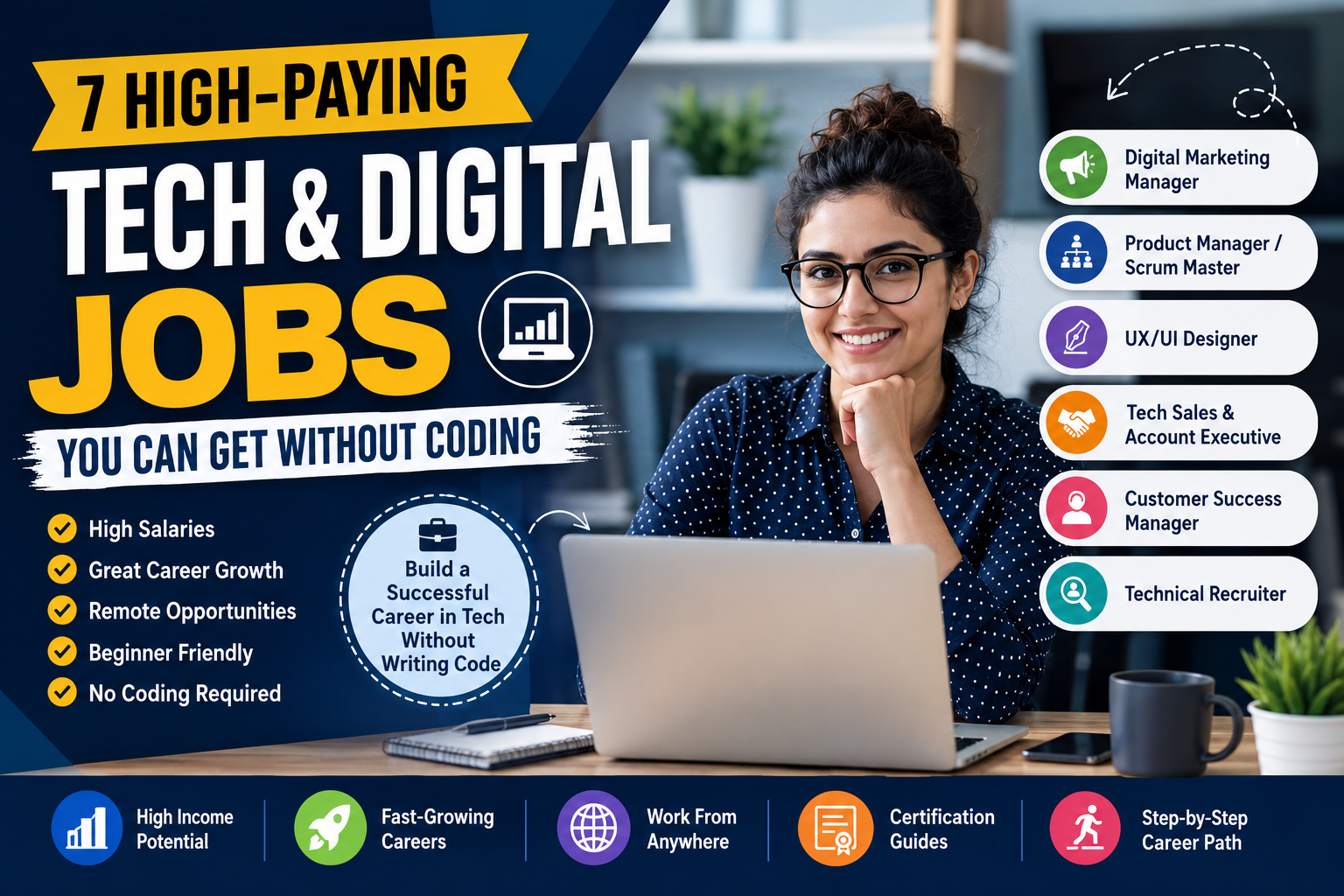
7 High-Paying Tech and Digital Jobs You Can Get Without Coding
A rewarding career in technology doesn’t always require becoming a software developer. Many of today’s fastest-growing roles focus on communication, business strategy, design, marketing, and leadership instead of programming.
Start Reading

Key Takeaways
- Technology companies hire thousands of professionals who never write production code.
- Digital marketing, product management, UX design, customer success, and tech sales are among the fastest-growing careers.
- Many professionals transition successfully from education, healthcare, engineering, retail, finance, and customer service.
- Strong communication, analytical thinking, leadership, and problem-solving skills are often more valuable than programming knowledge.
- Industry certifications and real-world projects help demonstrate practical skills to employers.
- Remote and hybrid work opportunities are widely available across many technology companies.
Table of Contents
Why the Tech Industry Needs Non-Technical Talent
When people imagine working in technology, they often picture software developers writing code all day. While software engineering remains an essential profession, successful technology companies rely on much more than programming. Every digital product also needs professionals who understand customers, create marketing campaigns, improve user experiences, manage projects, analyze business performance, build partnerships, recruit talented employees, and provide customer support.
Consider a company that develops project management software. Developers build the platform, but digital marketers attract new customers, product managers prioritize features, designers improve usability, customer success teams help clients achieve results, and sales professionals introduce the software to businesses. Without these roles, even the best technology product would struggle to grow.
This growing demand has created thousands of opportunities for professionals who enjoy solving business problems, communicating with people, organizing projects, or creating engaging online experiences. Many of these careers offer competitive salaries, flexible working arrangements, and excellent long-term growth without requiring advanced programming knowledge.
Real Career Insight
Many successful digital marketers, product managers, and customer success professionals began their careers in completely different industries such as retail, hospitality, teaching, banking, healthcare, or engineering. They built transferable skills, completed targeted training, and gained practical experience through personal or freelance projects before moving into technology-focused roles.
Transferable Skills That Technology Companies Value
Communication
Explaining ideas clearly to customers, colleagues, and stakeholders is essential across nearly every technology role.
Problem Solving
Technology companies value professionals who can identify challenges, analyze situations, and recommend practical solutions.
Project Management
Planning work, meeting deadlines, and coordinating teams are valuable skills in startups and large organizations alike.
Business Thinking
Understanding customer needs, market trends, and business objectives helps companies develop better products and services.
| Traditional Career | Technology Career |
|---|---|
| Teacher | Customer Success Manager |
| Sales Executive | SaaS Account Executive |
| Engineer | Product Manager |
| Nurse | Health Technology Specialist |
| HR Professional | Technical Recruiter |
| Marketing Executive | Digital Marketing Manager |
1. Digital Marketing Manager & SEO Specialist
Digital marketing has become one of the fastest-growing career paths within the technology industry. Every software company, online marketplace, mobile application, and digital startup depends on attracting visitors, generating leads, and converting potential customers into paying users. This creates strong demand for professionals who understand search engines, online advertising, content strategy, email marketing, analytics, and social media.
Unlike software engineering, digital marketing focuses on understanding customer behavior rather than writing application code. Professionals use data to improve website visibility, increase traffic, and help businesses grow online.
Main Responsibilities
- Search Engine Optimization (SEO)
- Google Ads Campaigns
- Content Marketing
- Email Marketing
- Website Analytics
- Keyword Research
- Conversion Optimization
Useful Skills
- Google Analytics
- Search Console
- Copywriting
- Content Strategy
- Problem Solving
- Communication
- Data Interpretation
| Experience Level | Typical Responsibilities |
|---|---|
| Entry Level | Content writing, social media, reporting |
| Mid-Level | SEO strategy, paid advertising, campaign management |
| Senior Level | Marketing leadership and growth strategy |
2. Product Manager
Product Managers help guide the development of digital products by working closely with designers, engineers, marketers, customer support teams, and business stakeholders. Their primary responsibility is identifying customer needs and deciding which improvements should be developed first.
Although Product Managers work with technical teams every day, they are not expected to write production software. Instead, they coordinate planning, communicate priorities, analyze customer feedback, and ensure everyone is working toward the same objectives.
Real-World Example
Imagine customers frequently request a new reporting feature inside a software application. Instead of building the feature themselves, a Product Manager researches customer demand, discusses technical feasibility with engineers, estimates business impact, and prioritizes development based on available resources.
| Daily Activities | Business Value |
|---|---|
| Product Planning | Defines future product direction |
| Customer Interviews | Identifies real customer problems |
| Roadmap Management | Prioritizes development work |
| Cross-Team Communication | Keeps departments aligned |
| Feature Evaluation | Improves customer satisfaction |
3. Scrum Master / Agile Project Manager
Modern technology companies often organize projects using Agile methodologies. Scrum Masters support development teams by facilitating meetings, removing obstacles, improving collaboration, and helping projects progress efficiently. Rather than acting as traditional managers, Scrum Masters serve as facilitators who encourage communication and continuous improvement.
Professionals entering this field commonly come from project coordination, operations, engineering, consulting, or business administration backgrounds.
Typical Tasks
- Sprint Planning
- Daily Stand-up Meetings
- Retrospectives
- Project Coordination
- Risk Management
- Stakeholder Communication
Professional Skills
- Leadership
- Organization
- Facilitation
- Conflict Resolution
- Communication
- Decision Making
Comparing These Career Paths
| Career | Coding Required? | Creativity | Communication | Growth Potential |
|---|---|---|---|---|
| Digital Marketing | No | ★★★★★ | ★★★★★ | ★★★★★ |
| SEO Specialist | No | ★★★★☆ | ★★★★☆ | ★★★★★ |
| Product Manager | No | ★★★★☆ | ★★★★★ | ★★★★★ |
| Scrum Master | No | ★★★☆☆ | ★★★★★ | ★★★★★ |
Helpful Certifications
While certifications are not a substitute for practical experience, they can demonstrate commitment to learning and provide structured knowledge. Hiring managers often value certifications when combined with real projects, internships, volunteer work, or measurable achievements.
| Career | Recommended Certification |
|---|---|
| Digital Marketing | Google Digital Marketing & E-commerce Certificate |
| SEO | Google Analytics Certification |
| Product Management | Product School Fundamentals |
| Scrum Master | Professional Scrum Master (PSM) or Certified ScrumMaster (CSM) |
Tip:
Rather than collecting many certificates, focus on completing one respected certification and applying what you’ve learned through personal projects, freelance work, internships, or volunteer experience. Employers often look for evidence that you can apply your skills in real situations.
4. UX/UI Designer
User Experience (UX) and User Interface (UI) designers help create digital products that are intuitive, accessible, and enjoyable to use. Rather than writing software, they focus on understanding user behavior, designing layouts, improving navigation, and ensuring that websites and applications solve real problems efficiently.
Many UX professionals come from graphic design, marketing, psychology, customer service, architecture, or creative industries. Modern design tools such as Figma and Adobe XD allow designers to build interactive prototypes without programming knowledge.
Typical Responsibilities
- User Research
- Wireframing
- Prototyping
- Design Systems
- Accessibility Improvements
- Usability Testing
Useful Tools
- Figma
- Adobe XD
- Miro
- Notion
- Maze
- Canva
5. Tech Sales & Account Executive
Technology companies depend on skilled sales professionals to explain products, understand customer requirements, and build lasting business relationships. Instead of selling physical products, many Account Executives introduce cloud software, cybersecurity solutions, AI platforms, and SaaS products to businesses.
Strong communication, negotiation, and relationship-building skills are usually more valuable than technical coding knowledge.
| Primary Responsibility | Business Impact |
|---|---|
| Product Demonstrations | Educates potential customers |
| Client Meetings | Builds trust and relationships |
| Negotiations | Supports revenue growth |
| Account Management | Improves customer retention |
6. Customer Success Manager
Customer Success Managers focus on helping customers achieve value after purchasing a product or service. Instead of finding new clients, they work with existing customers by providing onboarding, training, adoption guidance, and ongoing support.
Technology companies increasingly invest in Customer Success because retaining existing customers is often more cost-effective than acquiring new ones.
7. Technical Recruiter
Technical Recruiters help companies identify and hire professionals for engineering, cybersecurity, cloud computing, product management, design, and IT operations. They coordinate interviews, review resumes, communicate with candidates, and support hiring managers throughout the recruitment process.
People with HR, business administration, recruitment, or customer-facing experience often transition successfully into technical recruiting roles.
How to Pivot Into a Tech Career Without Coding
Changing careers doesn’t always require starting from scratch. Many skills developed in other industries are highly transferable to technology roles. Communication, leadership, project planning, customer service, organization, and analytical thinking are valuable across a wide range of technology careers.
| Your Current Career | Possible Tech Career |
|---|---|
| Teacher | Customer Success Manager |
| Engineer | Product Manager |
| Retail Manager | Operations Manager |
| Sales Professional | SaaS Account Executive |
| HR Executive | Technical Recruiter |
| Healthcare Professional | Health Technology Specialist |
Frequently Asked Questions
No. Many employers focus on practical skills, experience, communication abilities, and relevant certifications rather than specific degrees.
Yes. Entry-level opportunities exist in customer success, digital marketing, recruiting, technical sales, and project coordination.
Choose a certification that aligns with your target role. Google Digital Marketing, Professional Scrum Master, and the Google UX Certificate are common starting points.
Many technology companies offer remote or hybrid positions, although availability varies by employer and role.
Final Thoughts
The technology industry offers many rewarding careers beyond software development. Whether your strengths lie in communication, creativity, organization, leadership, or business strategy, there are opportunities to build a successful career without becoming a programmer.
Focus on developing practical skills, building a portfolio where appropriate, completing relevant certifications, and applying your existing experience to technology roles that value your strengths. Continuous learning and curiosity are often more important than following a traditional career path.